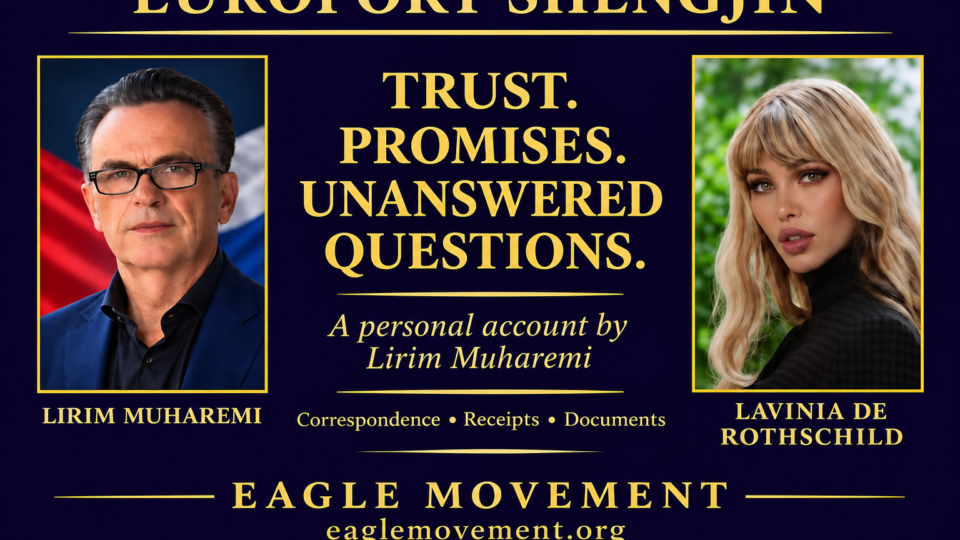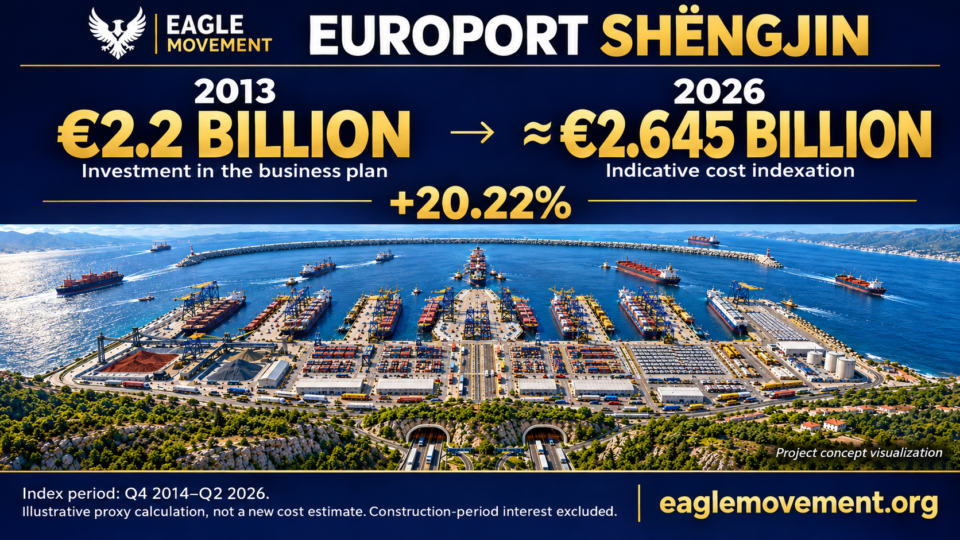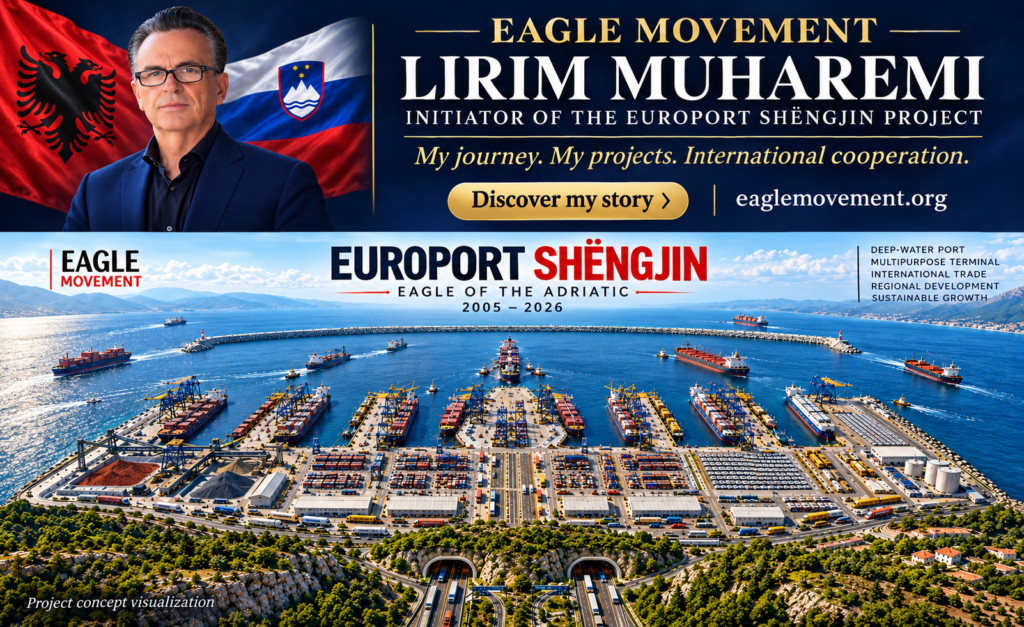
Europort Shëngjin is a documented story spanning more than two decades – from the original 2005 vision to Albanian and European institutions, China, and today’s call for an independent examination.
Europort Shëngjin 20 YEARS OF UNANSWERED QUESTIONS
The documented story of Lirim Muharemi — from the original vision developed in 2005 to the Albanian Government, European institutions, China and today’s call for an independent investigation
A personal statement by Lirim Muharemi and a chronological review of the Europort Shëngjin project
Europort Shëngjin is not a project that appeared yesterday. Its origins date back to 2005, when Lirim Muharemi began developing the vision of a new deep-water, industrial, logistics and intermodal port in Shëngjin , Albania.
This publication presents a chronology based on available documents, personal testimony and publicly available institutional records, and calls for an independent examination of the origin, authorship, circulation and possible later use of the project.
The documentary record preserved by Lirim Muharemi for more than two decades includes:
- 65 large technical and project sheets;
- documents identifying him as the investor;
- official letters and protocol records;
- correspondence involving Albanian and Slovenian representatives;
- direct correspondence with the European Investment Bank;
- documentation connected with the European Bank for Reconstruction and Development;
- presentations to potential Chinese investors;
- photographs and video recordings;
- international business publications;
- awards and physically preserved trophies;
- three passports containing a total of 499 border stamps;
- later Albanian strategic documents referring to the Port of Shëngjin , intermodal infrastructure and “ Shëngjin Europort”;
- the present-day institutional initiative requesting preservation and examination of the complete documentary trail.
This publication is not a judicial ruling and does not, by itself, establish criminal, civil or political responsibility.
It presents a chronology based on the available documents, the personal testimony of Lirim Muharemi and publicly available institutional records. Its purpose is to request an independent examination of the origin, authorship, circulation and possible later use of the project.
2004–2016: THREE PASSPORTS AND 499 BORDER STAMPS
Lirim Muharemi’s international activity is not reflected only in newspaper articles, photographs, awards and official correspondence.
Three of his passports have been preserved. Together, they contain:
499 border, entry and exit stamps covering the period from 2004 to 2016.
The first two passports contain a total of 446 stamps accumulated over approximately eight years. The third passport contains the remaining stamps from the later period, when the number of journeys decreased because of various personal, legal and business obstacles.
These passports constitute a physical and chronological record of extensive international travel connected with business activities, project presentations, meetings, the search for investors and the development of Europort Shëngjin and other economic initiatives.
Muharemi’s international activities took him to major European and global business centres, including London, Luxembourg and China. During part of this period, he also worked and operated in Shenzhen.
The number of stamps alone does not prove the purpose or content of any particular meeting. When examined together with letters, protocols, invitations, tickets, photographs, videos and contemporary publications, however, the passports can help establish whether Muharemi was present in a particular country at the time a documented presentation or meeting took place.
Any public display of the passports must conceal passport numbers, dates of birth and other protected personal information.
2005: THE ORIGINAL VISION OF Europort Shëngjin
In 2005, the initial conceptual vision of a major port and logistics complex in Shëngjin was developed.
The purpose was not merely to enlarge the existing local port. The project was conceived as a strategic maritime, industrial and logistics gateway for Albania and the wider region, capable of connecting:
- the Adriatic Sea with European and international maritime routes;
- Albania with Kosovo, North Macedonia and the wider Balkan hinterland;
- rail, road and maritime transport;
- industrial and logistics activities;
- energy and commercial infrastructure;
- international investors and financial institutions.
The port was intended to become one of Albania’s principal economic gateways to Europe and the world.
The 2005 materials constitute the claimed starting point of the project. Given their age and importance, Eagle Movement (Movement of the Eagle) supports professional authentication of the originals, their dates, authorship, commissioning records and all related institutional archive entries.
2007: “INVESTITORI – LIRIM MUHAREMI”
Documents entitled:
“PROJEKTI KONCEPTUAL I EUROPORTIT TË Shëngjin ”
contain the express identification:
“INVESTITORI – LIRIM MUHAREMI”
This wording directly connects Lirim Muharemi with Europort Shëngjin during the project’s early development.
The version documented during this period envisaged approximately:
- 40 million tonnes of annual cargo-handling capacity;
- implementation in several phases;
- approximately 1.945 million square metres of port territory;
- an estimated construction or investment value of approximately EUR 1.448 billion.
The figures changed as the project evolved. Later presentations and infrastructure descriptions referred to a capacity of approximately 60 million tonnes annually.
These versions should not be confused. They represent different stages in the development of the same broader port vision.
65 LARGE SHEETS OF TECHNICAL AND DEVELOPMENT DOCUMENTATION
The original project collection consists of 65 large sheets measuring approximately 50 × 60 centimetres. Lirim Muharemi’s name appears on the documentation.
The materials address, among other matters:
- a technical report;
- geological surveys;
- an environmental study;
- research concerning hazards and emergency conditions;
- a technical overview;
- organisational issues;
- economic and financial considerations;
- engineering solutions;
- operational procedures;
- port technology;
- transport connections;
- logistics activities;
- municipal and construction infrastructure;
- phased implementation;
- projected port capacity and development.
This was therefore not merely a project name or promotional presentation. It was an extensive collection of technical, organisational and economic documentation capable of being compared with later state and international projects.
Lirim Muharemi has preserved the original documentation and is prepared to make it available to competent Albanian, European, audit, judicial and investigative institutions.
2008–2010: INSTITUTIONAL PRESENTATIONS, INTERNATIONAL ACTIVITY AND LM&CO
Between 2008 and 2010, the technical, economic and investment development of the project continued.
Materials from this period document the work of LM&CO and presentations made to Albanian and international counterparts.
Muharemi did not present himself merely as the promoter of one port. He acted as an entrepreneur and the author of a broader economic vision for Albania.
His work included proposals and ideas concerning:
- monetary stability;
- foreign investment;
- transport infrastructure;
- industrial development;
- regional economic integration;
- Albania’s strategic position between the Adriatic and the Balkan hinterland.
2009–2010: WORLD FINANCE 100 AND RECOGNITION IN LONDON
Lirim Muharemi was selected for World Finance 100.
In the January–February 2010 World Finance 100 publication, he was identified as:
“LIRIM MUHAREMI — INVESTMENT & PROMOTIONS — ALBANIA”
The publication connected him with Kapital Invest and the project described as the “Eagle of the Adriatic”, Europort Shëngjin .
In London, he received a certificate and a glass trophy which he describes as the “Pyramid of Power.” Photographs, video recordings and the physical trophy have been preserved.
The presentation or recording was connected with the setting of the London Stock Exchange. For complete accuracy, the distinction must be clear: this was a World Finance recognition presented or recorded in the London Stock Exchange environment. It was not an award issued by the London Stock Exchange itself.
That distinction does not diminish the importance of the recognition. It demonstrates that an Albanian infrastructure vision and its promoter had already gained visibility in one of the world’s leading financial centres.
The precise official name of the glass trophy should be confirmed from its inscription and accompanying certificate before publication of the final documentary catalogue.
2010: “GOLDEN EAGLE OF THE ADRIATIC”
In 2010, the Albanian Chamber of Commerce awarded LM&CO a distinction for the Europort Shëngjin project:
“GOLDEN EAGLE OF THE ADRIATIC”
The project was described in the preserved record as:
“the prestigious project of the century.”
According to the documentation held by Muharemi, the distinction had previously been presented only to former Albanian Prime Minister Sali Berisha and Albanian President Bamir Topi.
In Muharemi’s case, this was not merely a nomination. The records describe LM&CO as the recipient of the award for Europort Shëngjin and its work on the development of the project.
2010: WORLD FINANCE AND EUROPEANCEO
In May–June 2010, World Finance published the cover story:
“REVIVING THE LEK”
EuropeanCEO presented Kapital Invest and Lirim Muharemi under the title:
“THE EAGLE HAS LANDED”
These were editorial and business-media recognitions, not additional physical awards.
Together with World Finance 100, the London presentation, the glass trophy and the recognition from the Albanian Chamber of Commerce, however, they show that Muharemi and Europort Shëngjin had gained international visibility before a major new port in Shëngjin appeared in later Albanian strategic documents.
THE CONNECTION BETWEEN SLOVENIA AND ALBANIA
An important part of the history is represented by letters from former Slovenian Minister of Transport Patrick Vlačič and State Secretary Igor Jakomin, dated 2 September.
The letters form part of the preserved documentary collection and show that Muharemi was in contact with senior representatives of the Slovenian transport administration.
For a complete documentary archive, the originals should be published with:
- the full date and year;
- the official position of each signatory;
- the addressee;
- the protocol or reference number;
- all referenced attachments;
- an official translation where necessary.
This will allow the public and competent institutions to determine exactly what was confirmed, to whom the project was presented and what role was played by each person or institution.
Europort Shëngjin was conceived as a project connecting countries, markets, knowledge and international capital. Its history is therefore not limited to Albania.
AFTER THE LETTERS: WITHDRAWAL OF SUPPORT, INSPECTIONS AND HEAVY FINANCIAL PENALTIES
According to Lirim Muharemi, the attitude of certain Slovenian representatives subsequently changed significantly.
He states that people who had previously provided letters or institutional support withdrew. This was followed by numerous police, inspection and administrative-offence proceedings connected with his hospitality business.
Muharemi states that penalties totalling tens of thousands of euros were imposed for alleged violations concerning the sale of alcohol and other matters.
According to him, these proceedings had a serious effect on:
- his business operations;
- his financial position;
- his international activities;
- the number of journeys he could undertake;
- the continued development of Europort Shëngjin ;
- his personal and family life.
Muharemi suspects that these proceedings may not have resulted solely from ordinary and impartial enforcement, and that political or other improper influence may have been involved.
He does not currently possess direct evidence connecting a specific person with an instruction to the police. He therefore does not present this suspicion as an established fact and does not claim that Patrick Vlačič or Igor Jakomin ordered police action against him.
Nevertheless, he believes that the chronology justifies independent examination of:
- when and why the earlier institutional support ended;
- who initiated or requested the individual inspections;
- whether the inspections were unusually frequent or disproportionate;
- whether equivalent standards were applied to comparable hospitality businesses;
- how the total penalties amounting to tens of thousands of euros were calculated;
- whether communications existed between political, administrative and police representatives;
- the eventual outcomes of the related court proceedings.
According to Muharemi, some of the disputes and consequences remain connected with proceedings before Slovenian courts.
This part of the history is not presented as proof of a conspiracy or as an established finding of responsibility against any named person. It is Muharemi’s personal testimony, which should be assessed against the letters, inspection files, penalty decisions and court records.
2012–2013: THE EUROPEAN INVESTMENT BANK
The documentary record refers to presentations connected with the European Investment Bank in December 2012 and to a visit or meeting in Luxembourg on 20 February 2013.
Because complete institutional accuracy is essential, Eagle Movement asks the EIB to examine:
- meeting records;
- participant lists;
- received presentations;
- written and electronic correspondence;
- internal registration references;
- any technical assessments;
- any subsequent circulation of the project documentation.
The occurrence of a presentation or meeting does not amount to an approval of financing. It should, however, be possible to determine what documentation was presented, who received it and how it was subsequently handled.
2013: FRIENDS OF EUROPE AND “NEW BALKAN ORDER”
Another important element of the international documentary record is Friends of Europe and the European policy publication Europe’s World.
The Summer 2013 edition of Europe’s World, Issue No. 24, published an article entitled:
“NEW BALKAN ORDER”
Lirim Muharemi was identified as:
“President & CEO of LM&CO”
The article connected him with:
“ Europort Shëngjin — Eagle of the Adriatic”
and presented the project with an intended annual capacity of approximately 60 million tonnes.
This publication is significant because it placed Europort Shëngjin within the wider European and Balkan economic context.
The project was presented not simply as a local harbour expansion but as regional infrastructure capable of affecting trade, logistics, development and geopolitical connectivity across the Balkans.
It constitutes a dated public record establishing the connection between Lirim Muharemi and Europort Shëngjin before the later Albanian government plans and international assessments.
2013: Europort Shëngjin AND THE PROMISE OF 300,000 JOBS
In 2013, a coalition led by Edi Rama came to power in Albania. During that political campaign and the formation of the new government, the Socialist Party publicly promised to create 300,000 new jobs.
In September 2013, Rama stated that his government had pledged to create 300,000 jobs and would work “day and night” to achieve that goal. Contemporary reporting confirms that this was a central promise of the 2013 programme.
According to the project documentation preserved by Lirim Muharemi, Europort Shëngjin or the expansion of the Port of Shëngjin also formed part of the new government’s infrastructure and development programme.
A major industrial and intermodal Europort could have created employment directly within the port and indirectly in:
- construction;
- logistics;
- rail and road transport;
- shipping;
- energy;
- warehousing;
- manufacturing;
- trade;
- tourism;
- associated services.
Despite the scale of the employment promise, Albania subsequently experienced major outward migration, particularly among young and economically active citizens.
Muharemi estimates that approximately one million Albanians, including a very large number of young people, left the country. Official figures vary according to the period, age group, citizenship and definition of migration. For this reason, the figure of one million should be presented as Muharemi’s estimate unless supported in the final publication by a precise official statistical series.
The central question remains:
What would Albania look like today if a major industrial Europort capable of generating employment at home had been built, instead of so many young Albanians being compelled to seek their future abroad?
2013: Europort Shëngjin — LM&CO
Documents from 2013 connect the project with the designation:
“ Europort Shëngjin / LM&CO”
A protocol record dated 18 October 2013 and identified as No. 436 reportedly provides an additional connection between LM&CO, Lirim Muharemi and the presentation of the project.
This record should be examined in the original archive of the competent institution.
The investigation should establish:
- who received the document;
- which attachments were submitted;
- whether technical documentation was included;
- to whom the materials were forwarded;
- what subsequent action was taken.
27 NOVEMBER 2013: PRESENTATION TO MINISTER EDMOND HAXHINASTO
Europort Shëngjin was presented on 27 November 2013 to the then Albanian Minister of Transport and Infrastructure, Edmond Haxhinasto.
This is a central event in the chronology because it demonstrates direct contact between the project’s promoter and the state authority responsible for transport infrastructure.
Lirim Muharemi presented the project as its investor, initiator and the holder of its development vision.
A presentation to a minister is not equivalent to a construction permit, concession or approval of state financing. It is, however, important evidence that the competent government department was aware of the project and the identity of the person presenting it.
24 DECEMBER 2013: MINISTERIAL LETTER TO THE EUROPEAN INVESTMENT BANK
The documentary collection refers to a letter from Minister Edmond Haxhinasto dated 24 December 2013 and connected with the European Investment Bank.
The letter represents an important institutional link between:
- Lirim Muharemi and LM&CO;
- Europort Shëngjin ;
- the Albanian Ministry of Transport and Infrastructure;
- the European Investment Bank.
A complete reconstruction requires examination of the ministry’s outgoing protocol, the EIB’s incoming register, all attachments to the letter and any subsequent internal correspondence.
EARLY 2014: CHINESE INVESTORS AND CCCC
During early 2014, Chinese commercial and infrastructure representatives were mentioned in connection with the project, including China Communications Construction Company — CCCC.
A presentation or meeting with a CCCC delegation took place on or around 28 February 2014.
CCCC is one of the world’s largest companies in the field of ports, transport and construction infrastructure. Contact with an international company of this scale therefore represented an important stage in the effort to develop Europort Shëngjin .
A clear distinction must nevertheless be maintained between:
- presenting a project;
- an expression of interest;
- exploring possible cooperation;
- a formal offer;
- a binding agreement;
- a final investment decision.
The documentation may establish contacts and presentations, but it should not be interpreted as proof of final financing without contractual evidence.
28 FEBRUARY 2014: THE DIRECT LETTER FROM THE EUROPEAN INVESTMENT BANK
A particularly important document is the European Investment Bank letter dated 28 February 2014, reference:
OpsA/MA-3/MR/cr
The letter was addressed to:
“LIRIM MUHAREMI & CO — for the attention of Mr Lirim Muharemi”
It referred directly to Muharemi’s request for EIB financial support for the construction of Europort Shëngjin .
The EIB requested additional information necessary for a preliminary assessment of eligibility and viability, including information concerning:
- the technical design;
- the financial structure;
- transport and cargo forecasts;
- environmental matters;
- procurement arrangements;
- project feasibility.
The letter is direct documentary evidence that the EIB considered the project at least at the level of a preliminary information and viability review.
It does not prove approval of a loan, final financing or formal acceptance of the project. It does prove official communication between the EIB and Lirim Muharemi & Co concerning the construction of Europort Shëngjin .
2014: “NEW PORT OF Shëngjin ” AMONG ALBANIA’S PRIORITY PROJECTS
In the Albanian Ministry of Transport and Infrastructure materials entitled “Transport Infrastructure Priority Projects 2014,” a project appears under the name:
“NEW PORT OF Shëngjin ”
The government document states that construction of the new Port of Shëngjin was a top priority within the Government Programme 2013–2017.
The project was described as a major industrial port with an intended annual capacity of approximately 60 million tonnes. The documentation also referred to the existence of a feasibility study and technical materials.
The ambition was for the new facility to become Albania’s largest industrial port and to assume a greater role than the existing industrial capacity in Durrës.
This is one of the most important points in the chronology.
The earlier project documentation used the name Europort Shëngjin . The later government material used New Port of Shëngjin .
Similarity of name, location and capacity does not by itself prove unlawful appropriation. It is, however, sufficient to justify an independent technical comparison of:
- the port designs;
- location plans;
- cargo capacities;
- transport connections;
- construction phases;
- economic calculations;
- environmental studies;
- the origin of the documentation used;
- the dates on which institutions received and circulated the materials.
2014: FROM A PROPOSED MEETING IN HUNGARY TO CHINA
According to Lirim Muharemi’s account and preserved materials, Minister Edmond Haxhinasto initially referred to a future meeting or continuation of discussions in Hungary.
The institutional discussions later continued at the highest level between Albania and China.
The precise sequence — including who proposed each meeting, which persons participated and what documentation was circulated — should be established from ministerial protocols, correspondence, videos and contemporary newspaper reports.
SEPTEMBER 2014: EDI RAMA DISCUSSES THE PORT OF Shëngjin IN CHINA
In 2014, Edi Rama was Prime Minister of Albania and Edmond Haxhinasto was Minister of Transport and Infrastructure.
From 9 to 12 September 2014, Rama attended the World Economic Forum’s Summer Davos meeting in Tianjin, China. On 10 September, he met Chinese Premier Li Keqiang.
The official Chinese government report confirms that the two prime ministers discussed cooperation in infrastructure, energy, agriculture and other areas of economic development.
Of particular importance is Rama’s statement reported by Albanian media on 11 September 2014.
Rama announced that the Chinese Premier had proposed a grant to the Albanian Government amounting to:
10 MILLION CHINESE YUAN
The grant was publicly described as financing for a project to transform the Albanian education system through innovation.
In the same statement, Rama said that the two prime ministers had also discussed the Port of Shëngjin , which he described as a major project for which there was concrete interest. The statement was reported at the time by Top Channel.
This creates a direct and verifiable connection between the Albanian Prime Minister’s visit to China and a major port project in Shëngjin .
The statement came only months after:
- Muharemi’s presentation of Europort Shëngjin to Minister Haxhinasto;
- the ministerial letter to the EIB;
- the EIB’s direct response to Lirim Muharemi & Co;
- contacts with Chinese infrastructure representatives;
- the appearance of “New Port of Shëngjin ” among Albania’s priority infrastructure projects.
A legitimate question therefore arises:
Which Shëngjin port project did Edi Rama present to the Chinese Premier as a major project attracting concrete interest? Who prepared the documentation used during those discussions, and was it connected with the project previously developed and presented as Europort Shëngjin ?
Eagle Movement does not allege without evidence that the grant of 10 million yuan was intended for Europort or was unlawfully concealed. The grant was publicly described as support for an education initiative.
However, the grant and concrete Chinese interest in the Port of Shëngjin were publicly mentioned in the same statement.
It is therefore legitimate to request publication of:
- the complete programme of the Albanian delegation;
- the list of delegation members;
- the record of the meeting between Rama and Li Keqiang;
- all materials concerning the Port of Shëngjin presented to the Chinese side;
- the origin of the technical and economic documentation;
- communications between the ministry, the Prime Minister’s Office and Chinese companies;
- records showing receipt, purpose and use of the 10-million-yuan grant.
The chronology is clear. Europort Shëngjin was presented to Albanian and international institutions. A project called New Port of Shëngjin later appeared among state priorities. In September 2014, the Albanian Prime Minister publicly confirmed concrete Chinese interest in a major port project in Shëngjin .
Whether these were different projects or successive presentations of the same underlying concept can be determined only by comparing the documents.
31 JULY 2018: AN INTERMODAL PORT IN THE GOVERNMENT’S STRATEGIC PLAN
On 31 July 2018, the Albanian Council of Ministers adopted Decision No. 480.
Within the state strategic framework extending to 2030, the government referred to the construction of an intermodal port in Shëngjin :
“Ndërtimi i një porti intermodal në Shëngjin ”
Many years after Muharemi’s original project and institutional presentations, the idea of a major intermodal port in Shëngjin therefore appeared in an official Albanian government strategy.
The decision does not identify the origin of the concept and does not prove that Muharemi’s documentation was used.
It does create an important chronological and substantive connection that should be examined.
The central question is:
How did the concept documented as Europort Shëngjin in 2005–2007 evolve into an official government plan for an intermodal port in Shëngjin in 2018?
2019: AN EBRD-RELATED DOCUMENT USES THE NAME “ Shëngjin EUROPORT”
In 2019, the name of the project appeared again in an assessment prepared in connection with European Bank for Reconstruction and Development Project 50123.
The assessment contains a separate section entitled:
“ Shëngjin EUROPORT”
It states:
“The Shëngjin Europort is a proposed development of the Port of Shëngjin .”
The project is described as a proposed port development and as a possible major industrial port for Albania.
Its described characteristics include:
- approximately 60 million tonnes of annual capacity;
- regional economic importance;
- transport connections with Kosovo, North Macedonia and the wider Balkan hinterland;
- connections in the Rençi area;
- two tunnels forming part of the wider transport links;
- major industrial and logistics functions.
The assessment also recorded that, at the time of writing, no investment had yet been made in the project.
This was not a letter addressed by the EBRD directly to Lirim Muharemi. It does not establish that the EBRD financed Europort Shëngjin .
The EBRD was connected with the road or infrastructure project for which Europort was considered a possible cumulative development affecting the wider area.
The document is nevertheless extremely important for a different reason.
Approximately fourteen years after the beginning of Europort Shëngjin , and several years after Muharemi had presented it to the Albanian Ministry, the EIB and Chinese counterparts, EBRD-related documentation again contained:
- the name “ Shëngjin Europort”;
- the capacity of 60 million tonnes annually;
- regional transport connections;
- the Rençi area;
- two connecting tunnels;
- the project’s industrial and logistics function.
These characteristics had already appeared in earlier Europort Shëngjin materials and in the 2013 Europe’s World article “New Balkan Order.”
This raises several questions:
From which original source did the authors obtain the name “ Shëngjin Europort”?
Who supplied the figure of 60 million tonnes annually?
Which study provided the information about regional connections, the Rençi area and the two tunnels?
Was documentation previously submitted by Lirim Muharemi to Albanian institutions used?
Why was the project still described in 2019 as a proposed development in which no investment had been made?
Were the EBRD, the Albanian Development Fund and the authors aware of the origin of the concept and Muharemi’s role?
Eagle Movement asks the EBRD, the Albanian Development Fund and the competent Albanian institutions to disclose:
- all sources used;
- the commissioning body and authors of the assessment;
- all underlying technical documentation;
- communications concerning the “ Shëngjin Europort” section;
- the identity of persons who supplied the information;
- all earlier studies on which the description was based.
The 2019 document does not prove that the EBRD appropriated or financed Muharemi’s project.
It does prove something highly significant:
The name Shëngjin Europort and its principal technical characteristics remained present many years later in an official professional environment connected with a major European financial institution.
The origin of that information must therefore be established.
FROM Europort Shëngjin TO PORTO ROMANO
In later years, Albania began promoting other major port and logistics projects, particularly the relocation of commercial activities from the existing Port of Durrës to a new facility at Porto Romano.
Eagle Movement does not claim that Porto Romano is identical to Europort Shëngjin . The location and individual elements differ.
However, similarities in scale, industrial purpose, logistics connections, intermodal planning and the historical sequence create a legitimate public interest in an independent comparison.
That comparison must determine:
- which solutions had already been developed within Europort Shëngjin ;
- which institutions received the original documentation;
- how the project later appeared in government strategies;
- whether any elements were transferred into other projects;
- how authorship of later solutions was determined;
- whether the rights of the original promoter and investor were respected.
These are not predetermined accusations. They are questions that can be answered only by archive records and an independent technical comparison.
2026: PORTO ROMANO AT A STANDSTILL — ALBANIA CAUGHT BETWEEN AN OLD PORT AND A NEW ONE THAT DOES NOT YET EXIST
The present state of Porto Romano raises serious questions about the decision to begin withdrawing commercial functions from the existing Port of Durrës before the replacement commercial port had been completed and made operational.
The Albanian Government planned to relocate commercial port operations approximately nine kilometres north of Durrës to Porto Romano.
The existing Port of Durrës was then intended to be transformed into the tourist, marina and real-estate project known as Durrës Yachts & Marina.
As of 2 September 2026, however, there is a major difference between the promise and the reality.
Two tender procedures, two cancellations
The international tender for the first phase of Porto Romano, valued at approximately 39.3 billion lek — around EUR 393–400 million — was initially launched in July 2024.
The procedure was cancelled after the submitted offers were considered inadequate.
A second tender was opened at the end of December 2024. That procedure was accompanied by objections, the disqualification of international competitors and questions about the bid-evaluation process.
In March 2026, the second procedure was also cancelled after only one bidder remained.
The result is clear:
The new commercial port intended to receive the operations of Durrës has not been built.
The project is in an infrastructure and institutional standstill.
The tender file and SPAK
In February 2026, Albania’s Special Structure Against Corruption and Organised Crime — SPAK — seized documentation connected with the Porto Romano tender.
Seizure of documents does not, by itself, establish corruption or the criminal responsibility of any person.
It does show that questions surrounding the procedure were serious enough to be examined by Albania’s specialised anti-corruption authority.
Eagle Movement therefore does not state that corruption has already been proven. It asks:
- Why did two major international tender procedures fail?
- Why were internationally recognised bidders excluded?
- Who prepared the tender conditions?
- Who evaluated the bids?
- Was the process open, competitive and impartial?
- How much public money has already been spent without construction beginning?
- Who will be accountable for delays and economic consequences?
The European Commission’s 2025 Albania Report also recorded that construction had not yet begun at the time of its assessment, although the prequalification procedure had advanced.
A location requiring extensive dredging and reclamation
Porto Romano is not a naturally completed deep-water location at which major commercial operations can begin without extensive preliminary works.
The design requires:
- dredging of the approach and port basin;
- breakwaters and revetments;
- new quay walls;
- reclamation and filling;
- container-terminal yards;
- new road and rail connections.
This does not mean that a port cannot technically be built there.
It means that the location requires difficult, expensive and time-consuming marine engineering and major interventions in the coastal environment.
Muharemi describes the site critically as a shallow, marshy or lagoon-like area. In technical terms, the more precise statement is that its natural depth and ground conditions require extensive dredging, stabilisation, reclamation and protective infrastructure.
The old port is being transformed while the replacement is not ready
The greatest risk to Albania arises if capacity at the existing Port of Durrës is reduced or removed while Porto Romano remains unbuilt.
The Albanian authorities announced that all commercial activity would ultimately be transferred from Durrës. After two failed tender procedures, however, the country still does not possess the completed replacement facility required to receive all of that traffic.
If terminals at Durrës are reduced faster than replacement capacity is constructed, the consequences may include:
- reduced national cargo-handling capacity;
- import and export delays;
- higher logistics costs;
- cargo being redirected to ports in other countries;
- loss of clients and international partners;
- weakened competitiveness;
- direct and long-term economic damage to Albania.
Muharemi states that a substantial part of the terminal capacity that previously operated in Durrës is no longer functioning and that further pressure exists to remove the remaining commercial activities.
The exact extent of any reduction must be established through public operational data from the Durrës Port Authority. The authority should publish a year-by-year comparison showing:
- active terminals;
- cargo volumes;
- berth availability;
- ships served;
- capacity removed or transferred;
- revenues and lost traffic.
What did Mohamed Alabbar say?
Mohamed Alabbar is primarily connected with the transformation of the existing Port of Durrës into Durrës Yachts & Marina. He is not the contractor selected to construct the new commercial port at Porto Romano.
In August 2026, Albanian media interpreted public comments attributed to Alabbar as an acknowledgement that the Durrës marina project had been initiated or advanced too quickly, before all key issues had been resolved.
Those reports do not establish that Alabbar has definitively withdrawn from the project, nor that he has accepted responsibility for the failure of the Porto Romano tender.
They do, however, reinforce the need to examine whether the decision to transform the existing commercial port was made prematurely.
The Albanian Government should publish:
- all current contracts and amendments with private investors;
- the real implementation schedule for Durrës Yachts & Marina;
- the obligations of the state and investors;
- the conditions governing relocation of commercial activities;
- the consequences of delays at Porto Romano;
- the valuation of public land and other state assets;
- the allocation of costs, risks and future revenues.
Albania caught between two ports
Albania now faces a dangerous contradiction:
The existing commercial Port of Durrës is intended to give way to a tourism and real-estate development. The new commercial port at Porto Romano, which should replace it, remains unbuilt after two failed tender procedures.
This is no longer only a debate about a future vision. It is a present strategic and economic risk.
Muharemi believes that no functioning commercial port should have been dismantled, reduced or committed to another use before a technically verified, fully financed and operational replacement was secured.
This is precisely why the history of Europort Shëngjin has again become relevant.
Europort Shëngjin was conceived in 2005 as a major industrial, logistics and intermodal development. It had a documented technical vision, international presentations and evidence of interest from European and Chinese counterparts.
Instead of a transparent continuation or independent evaluation of that early project, Albania later chose a different direction.
Today, the existing commercial port is under pressure from redevelopment, while its proposed replacement has no successfully completed construction tender and has become the subject of institutional scrutiny.
Eagle Movement does not claim as an established fact that the Europort documentation was stolen or that Porto Romano is a copy.
It does claim that the abandonment, rejection or unexplained transformation of an earlier professionally developed solution may have contributed to the position in which Albania finds itself today.
A historic strategic error?
The issue is no longer only who first proposed a major industrial port.
The question is whether Albania has lost years, investment opportunities, commercial capacity and economic development because of opaque decisions, an incorrect sequence of projects and the failure to examine an already developed concept transparently.
If Europort Shëngjin was technically unsuitable, the institutions should publish the professional assessments by which it was rejected.
If it was suitable, they should explain why it was not continued.
If its solutions were later used, their origin should be established and their authorship recognised.
If Porto Romano remains the best solution, the Government should disclose:
- a realistic construction schedule;
- secured financing;
- depth and dredging requirements;
- complete tender documentation;
- environmental effects;
- the plan for uninterrupted port operations;
- the actual economic cost of delays.
Albania does not need another slogan.
It needs an operational port, transparent contracts, protection of public assets, accountability for public money and the complete documentary truth.
2026: THE Eagle Movement PUBLIC AND INSTITUTIONAL INITIATIVE
In 2026, Eagle Movement prepared a documented initiative seeking an institutional examination of the history of Europort Shëngjin .
The initiative requests consideration by:
- competent Albanian state institutions;
- the European Investment Bank;
- the European Bank for Reconstruction and Development;
- competent bodies of the European Union;
- the European Anti-Fraud Office — OLAF;
- other competent audit, supervisory, financial and investigative authorities.
The purpose is not for Eagle Movement to declare that fraud, corruption or unlawful appropriation has already been proven.
The purpose is to:
preserve the relevant documents and archives;
reconstruct the complete movement of the project documentation;
verify dates, authorship and recipients;
compare the original and later technical solutions;
determine the role of state and international institutions;
protect the rights of the original promoter and investor;
present the public with a verifiable history of the project.
Document EM-EUS-BIT-NOD-01/2026 represents a separate institutional initiative and should be examined together with its evidentiary annexes. It does not replace the original historical documentation.
WHO IS LIRIM MUHAREMI IN THIS HISTORY?
Lirim Muharemi is not an outside observer who appeared only after the publication of government plans.
The documentary record identifies or presents him as:
- the investor;
- the initiator;
- the project holder;
- President and CEO of LM&CO;
- the author or developer of a broader economic vision;
- the person who presented the project to Albanian and international institutions.
His name is connected with:
- the original project documentation;
- ministerial presentations;
- the European Investment Bank;
- Friends of Europe and Europe’s World;
- World Finance;
- EuropeanCEO;
- the Albanian Chamber of Commerce;
- Chinese infrastructure contacts;
- the preserved international travel record.
For more than twenty years, he retained the original plans, correspondence, publications, photographs, videos, awards and passports.
He does not ask the public to accept his interpretation without verification.
He asks for something more fundamental:
Open the documents. Compare them. Establish their origin. Follow their path. Allow the truth to be independently verified.
QUESTIONS THE INSTITUTIONS MUST ANSWER
When did Albanian institutions first receive the Europort Shëngjin documentation?
Which ministries, officials, advisers and other persons had access to it?
Which attachments accompanied the presentations made in 2012, 2013 and 2014?
Do complete registers of communications with the EIB, EBRD and Chinese companies exist?
How did “ Europort Shëngjin ” become “New Port of Shëngjin ” in government presentations?
Which project did Edi Rama discuss with the Chinese Premier in September 2014?
What was presented to the Chinese side and who prepared it?
What is the origin of the designation “ Shëngjin Europort” in the 2019 EBRD-related assessment?
Where did the authors obtain the figure of 60 million tonnes, the Rençi connection and the two-tunnel concept?
Were any original technical, organisational or economic solutions used in later projects?
Were the rights of Lirim Muharemi as the named investor and project promoter respected?
What relationship, if any, exists between Europort Shëngjin , the 2018 government plan for an intermodal port and later Albanian port projects?
Why was the existing Port of Durrës committed to redevelopment before Porto Romano was completed?
What are the present operational consequences of reducing commercial capacity in Durrës?
Why did two Porto Romano tender procedures fail?
What documentation has been requested or seized by SPAK, and what is the current status of that review?
How much public money has been spent on plans, procedures and preparatory work without construction of the new commercial port?
Can a complete chronology of the circulation and use of the Europort documentation be produced?
Why was a project capable of creating major employment opportunities never implemented in its originally presented form?
WE DO NOT DEMAND BLIND TRUST — WE DEMAND VERIFICATION
Eagle Movement does not ask anyone to accept these conclusions solely on the basis of a public statement.
We request:
- inspection of the original documentation;
- an independent technical comparison;
- opening of Albanian and European institutional archives;
- confirmation of meetings and protocol records;
- complete traceability of all submitted materials;
- disclosure of the sources used in later project descriptions;
- examination of communications with Chinese counterparts;
- review of the Porto Romano tender history;
- protection of authorship and investor rights;
- accountability for decisions affecting Albania’s strategic port infrastructure.
If every procedure was lawful and proper, an independent examination will confirm it.
If irregularities occurred, the competent institutions must establish them through documents, evidence and lawful proceedings.
A PROJECT THAT SURVIVED FOR MORE THAN TWO DECADES
Europort Shëngjin is not only the story of a port.
It is the story of a project that began in 2005.
A project developed across 65 large technical sheets.
A project in which the words:
“INVESTITORI – LIRIM MUHAREMI”
were placed beside the name of its promoter.
A project presented to ministers, European financial institutions, Friends of Europe, international business media and Chinese infrastructure representatives.
A project for which Lirim Muharemi and LM&CO received Albanian and international recognition.
A project whose name and principal development characteristics later appeared again in Albanian and internationally connected documents.
A project that could have supported industrial growth, regional connectivity and employment.
And above all, it is a history that has still not received a complete institutional answer.
After more than twenty years, the time has come to collect the documents in one place, reconstruct their path and present the complete history to the public.
The documents exist.
The dates exist.
The letters exist.
The awards exist.
The three passports and 499 border stamps exist.
The project exists.
Now the institutions must answer.
Lirim Muharemi
Initiator and Investor of Europort Shëngjin
Founder of Eagle Movement
Eagle Movement
For truth, transparency, accountability and a new Albania.
www.eaglemovement.org